|
 The final game in the history of the All America Football
Conference (1946-1949) is generally regarded as the final
championship game that took place on December 11, 1949 at
Municipal Stadium in Cleveland, Ohio. In that game, the
Cleveland Browns would win their fourth consecutive AAFC title.
The Browns were the only team to ever win the AAFC championship,
having won it four straight years from 1946 through 1949. In
that final championship game, the Browns defeated the San
Francisco 49ers, 21-7. But, this was not the final game in AAFC
history. The final game actually occurred on December 17, 1949
at the Shamrock Charity Bowl All-Star Game at Rice Stadium in
Houston, TX. The final game in the history of the All America Football
Conference (1946-1949) is generally regarded as the final
championship game that took place on December 11, 1949 at
Municipal Stadium in Cleveland, Ohio. In that game, the
Cleveland Browns would win their fourth consecutive AAFC title.
The Browns were the only team to ever win the AAFC championship,
having won it four straight years from 1946 through 1949. In
that final championship game, the Browns defeated the San
Francisco 49ers, 21-7. But, this was not the final game in AAFC
history. The final game actually occurred on December 17, 1949
at the Shamrock Charity Bowl All-Star Game at Rice Stadium in
Houston, TX.
The National Football League and the All-America Football
Conference had fought a nasty bidding war for players in the
1940’s, but the sides had called a truce on December 11, 1949
when they announced a merger. The Browns and 49ers, along with
the Baltimore Colts, would all be merged into the NFL for the
1950 season. The other AAFC teams ceased to be as the Buffalo
Bills were merged with the Browns, the New York Yankees were
split among the New York Giants and the New York Bulldogs and
the Los Angeles Dons mixed with the L.A. Rams. The only team
left out in the cold were the Chicago Rockets, who were
disbanded.
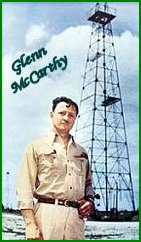 For
the City of Houston, there was hope that the formation of the
new National-American Football League would bring an expansion
team to South Texas. Glenn "Diamond
Glenn" McCarthy, Houston oil tycoon, announced that he would
sponsor an AAFC All-Star Game as a charity event to raise money
for Holly Hall (Home for the Aged) of Houston, the Damon Runyon
Cancer Fund and National Kids Day Foundation. In 1949, McCarthy
had opened his $21 million Shamrock Hotel on St. Patrick’s Day.
McCarthy owned many companies, over 400 gas and oil wells in
Texas and was president of the United States Petroleum
Association. McCarthy was a visionary Houstonian who loved his
community and football. He dreamed of Houston being a
professional football town. He had been tentatively
assured of a new franchise by the AAFC, but that promise faded
away with the merger. He was also a well connected man
whose friends included Hollywood celebrities. His Shamrock Bowl
would give the community exposure and expose the community to
professional football. The city had never before hosted a
professional football game of this magnitude. It was McCarthy’s Shamrock Bowl that
would be the curtain call for the AAFC. For
the City of Houston, there was hope that the formation of the
new National-American Football League would bring an expansion
team to South Texas. Glenn "Diamond
Glenn" McCarthy, Houston oil tycoon, announced that he would
sponsor an AAFC All-Star Game as a charity event to raise money
for Holly Hall (Home for the Aged) of Houston, the Damon Runyon
Cancer Fund and National Kids Day Foundation. In 1949, McCarthy
had opened his $21 million Shamrock Hotel on St. Patrick’s Day.
McCarthy owned many companies, over 400 gas and oil wells in
Texas and was president of the United States Petroleum
Association. McCarthy was a visionary Houstonian who loved his
community and football. He dreamed of Houston being a
professional football town. He had been tentatively
assured of a new franchise by the AAFC, but that promise faded
away with the merger. He was also a well connected man
whose friends included Hollywood celebrities. His Shamrock Bowl
would give the community exposure and expose the community to
professional football. The city had never before hosted a
professional football game of this magnitude. It was McCarthy’s Shamrock Bowl that
would be the curtain call for the AAFC.
The game, which would pit the champion of the AAFC against a
team of all-stars selected from the other six AAFC franchises,
was the only all-star contest in the league’s history. An
imposing array of talent was picked for the game. The Cleveland
Browns qualified by defeating the 49ers and they boasted perhaps
the greatest team in the history of professional football to
that point. The Browns went 14-0 in 1948 and were,
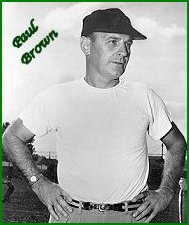 along with
the 1972 Miami Dolphins, one of only two teams in professional
football history to accomplish an undefeated season. Led by
quarterback, Otto Graham, and coached by the legendary Paul
Brown, the Browns had posted a 56-4-3 record in their history.
Stars for the Browns included fullback, Marion Motley, ends,
Dante Lavelli, Mac Speedie and John Yonakor and center, Lou
Saban. The All-Stars were led by rookie sensation, Y.A. Tittle,
at quarterback from the Baltimore Colts, fullback, Joe Perry of
San Francisco, and halfbacks, Buddy Young and Tom Landry of the
New York Yankees. The All-Stars were coached by Red Strader of
the Yankees and he and his assistants arrived in Houston about
ten days before the game to begin the preparation. Strader’s
Yankees had lost a semi-final playoff game to San Francisco. The
Browns arrived in Houston by rail on December 14, three days
after their championship game victory in Cleveland. The Houston
citizens were excited that the Browns arrived so soon and began
to limber up at the Stadium just hours after checking in at the
Shamrock. The weather in Houston during the week was
disappointing, rainy and cold. But, Paul Brown had no problem
with the elements having just come from miserable conditions the
week before in Cleveland. When asked upon arrival if the rains
would alter his team’s practice plans, Brown responded, “I don’t
see why it should. We have been practicing and playing in rain
all season.” Houston was so focused on the game that the Houston
Chronicle headline following the AAFC championship read, “Browns
Brush Aside 49ers To Qualify For Bowl Game.” along with
the 1972 Miami Dolphins, one of only two teams in professional
football history to accomplish an undefeated season. Led by
quarterback, Otto Graham, and coached by the legendary Paul
Brown, the Browns had posted a 56-4-3 record in their history.
Stars for the Browns included fullback, Marion Motley, ends,
Dante Lavelli, Mac Speedie and John Yonakor and center, Lou
Saban. The All-Stars were led by rookie sensation, Y.A. Tittle,
at quarterback from the Baltimore Colts, fullback, Joe Perry of
San Francisco, and halfbacks, Buddy Young and Tom Landry of the
New York Yankees. The All-Stars were coached by Red Strader of
the Yankees and he and his assistants arrived in Houston about
ten days before the game to begin the preparation. Strader’s
Yankees had lost a semi-final playoff game to San Francisco. The
Browns arrived in Houston by rail on December 14, three days
after their championship game victory in Cleveland. The Houston
citizens were excited that the Browns arrived so soon and began
to limber up at the Stadium just hours after checking in at the
Shamrock. The weather in Houston during the week was
disappointing, rainy and cold. But, Paul Brown had no problem
with the elements having just come from miserable conditions the
week before in Cleveland. When asked upon arrival if the rains
would alter his team’s practice plans, Brown responded, “I don’t
see why it should. We have been practicing and playing in rain
all season.” Houston was so focused on the game that the Houston
Chronicle headline following the AAFC championship read, “Browns
Brush Aside 49ers To Qualify For Bowl Game.”
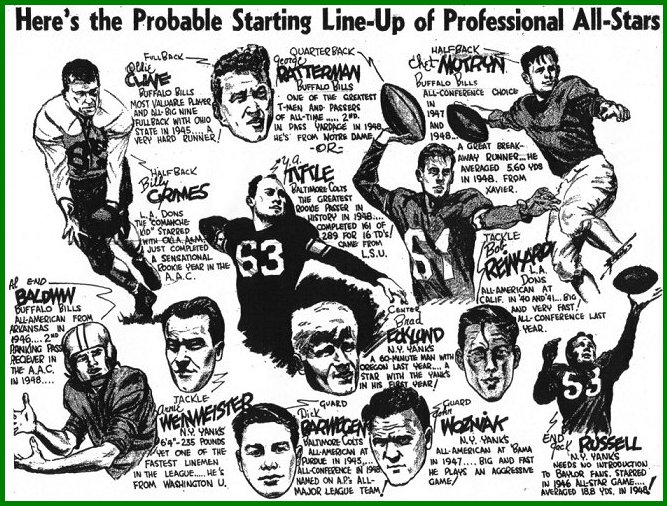
Houston Chronicle
The
game was scheduled for a 2:00 pm kick-off with entertainment
preceding it at 1:00 by radio stars, Jack Benny, Phil Harris
(who starred on the Jack Benny Show) and Dinah Shore. The three
entertained the crowd of 12,000 in a downpour. Benny wore a
Shamrock Hotel patrolman’s raincoat and was munching on a
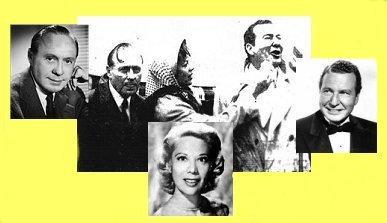 hotdog. The fans, although small in number, were very
enthusiastic about professional football coming to Houston. hotdog. The fans, although small in number, were very
enthusiastic about professional football coming to Houston.
The first ten minutes of the game was a mud brawl as neither
team threatened. After two failed offensive series for the
Stars, Coach Strader pulled quarterback George Ratterman of
Buffalo in favor of San Francisco’s Frankie Albert. Late in the
first period, the All-Stars mounted a drive. Albert led the
Stars on a 16 play drive starting from his own 32. Albert passed
for 40 yards on the drive, connecting on passes to Chet Mutryn
of Buffalo and Lamar Davis of the Colts to move the ball to the
26 yard line of the Browns. He then hit Otto Schnellenbacher of
the Yankees for a first down at the 15. Buddy Young of the
Yankees picked up 5 yards to the 9 and Joe Perry of the 49ers
got five and a first down at the four. From there, Mutryn
carried twice for the score. His touchdown coming on a two yard
dive into the end zone with 1 ½ minutes to play in the first
quarter. Albert’s extra point was blocked by the Browns’ line
and the Stars led 6-0.
On the last play of the first quarter, the Browns Marion Motley
burst through the line a jaunted 59 yards. He was brought down
on the Stars 25 yard line. The Browns surged on the ground to
the 2 yard line, but were held on a goal line stand at the one.
The All-Stars were forced to punt from deep in their own
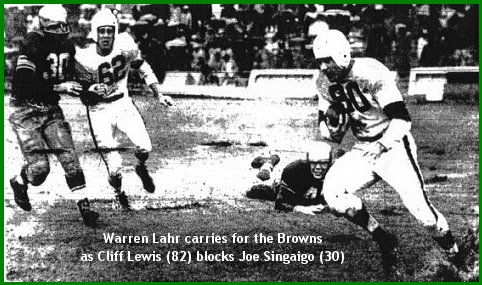
territory. The Yankees’ Tom Landry punted to Cliff Lewis who
returned it to the Stars’ 40. On the first play, Graham hit Dub
Jones who took it in at the five and skidded across the goal
line. Lou Groza’s extra point made the score 7-6 in favor of the
Browns.
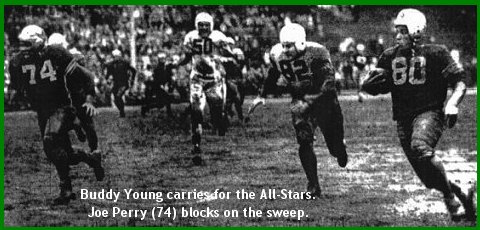
 On the ensuing kick off, the Stars were assessed a penalty for
clipping and had to start at their own 9 yard line. From there,
the Stars mounted a 91 yard drive on 12 plays behind the passing
of Albert and the running of Young. The big play of the drive
came from the Browns’ 26, when Young shot off tackle, sprinted
to his right and took the ball 23 yards to the Cleveland 13.
After a loss of 2 on first down, Albert, completely surrounded
by Browns, passed to Al Baldwin of Buffalo who shook off
defenders at the 5 and carried it in for a 25 yard touchdown.
The score was 12-7 at the half. On the ensuing kick off, the Stars were assessed a penalty for
clipping and had to start at their own 9 yard line. From there,
the Stars mounted a 91 yard drive on 12 plays behind the passing
of Albert and the running of Young. The big play of the drive
came from the Browns’ 26, when Young shot off tackle, sprinted
to his right and took the ball 23 yards to the Cleveland 13.
After a loss of 2 on first down, Albert, completely surrounded
by Browns, passed to Al Baldwin of Buffalo who shook off
defenders at the 5 and carried it in for a 25 yard touchdown.
The score was 12-7 at the half.
In the second half, the defenses played to a stalemate in the
mud. The Browns threatened three times in the fourth quarter.
Early in the period, the Browns drove from the All-Stars 44 to
the 16, but Jim Cason of San Francisco intercepted a Graham
pass. With eight minutes left, the Browns got a huge break when
Young fumbled a pitch out from Albert and George Young recovered
at the Stars’ 21. But, on fourth down from the 17, Graham’s pass
to Edgar Jones was knocked down by Pete Layden of the Yankees.
The Browns got one more chance starting at their own 32 after a
punt late in the game. With passes to Dante Lavelli (29 yards)
and Tom James (12 yards), Graham moved the champions to the
All-Star 29. But, the Stars sacked Graham for a ten yard loss on
first down and held the Browns from there. The final was 12-7.
The All-Star defense put pressure on Graham all day. It was
unusual for the Browns to encounter such stern resistance in
their short
history. Graham was sacked for 55 yards in losses.
It was only the fifth loss in franchise history.
It was the first game in the city's history that the players
and the fans in the stands were integrated. The newspapers
of the day noted the lack of racism among the Houston crowd as
Buddy Young received the loudest cheers throughout the
afternoon. He was the leading ground gainer on the day, rushing
for 75 yards in 12 carries as the All-Stars out-rushed the
Browns 162-82 yards. The Browns’ Motley rushed for 69 yards in 8
carries. Graham was 8 of 19 passing for 101 yards. Albert
completed 6 of 13 for 70 yards.
 The crowd was amazed at the professional spectacle. They
remained throughout the afternoon, in spite of the weather. One
fan was asked if she liked the game. She said, “Did I like the
game? I sat through it didn’t I?” Jess Neely, coach of the Rice
Owls was impressed at the tenacious play by the pros, given the
rough weather. It was the last game at the old Rice Stadium. A
new 50,000 seat Stadium was to open the next season. It was the
final game in the history of the AAFC and may have been a
fitting ending. The Browns had dominated their league like no
team before or since. The All-Stars took the opportunity to show
their abilities and to prove that the talent in the league was
not confined to the Cleveland organization solely. The Browns
would survive this loss to win the world championship in their
1950, Cinderella season in the NFL. McCarthy’s dream of
professional football for Houston would come to pass, but her
citizens would have to wait 11 years for the formation of
another upstart league, the American Football League, and the
Houston Oilers. The crowd was amazed at the professional spectacle. They
remained throughout the afternoon, in spite of the weather. One
fan was asked if she liked the game. She said, “Did I like the
game? I sat through it didn’t I?” Jess Neely, coach of the Rice
Owls was impressed at the tenacious play by the pros, given the
rough weather. It was the last game at the old Rice Stadium. A
new 50,000 seat Stadium was to open the next season. It was the
final game in the history of the AAFC and may have been a
fitting ending. The Browns had dominated their league like no
team before or since. The All-Stars took the opportunity to show
their abilities and to prove that the talent in the league was
not confined to the Cleveland organization solely. The Browns
would survive this loss to win the world championship in their
1950, Cinderella season in the NFL. McCarthy’s dream of
professional football for Houston would come to pass, but her
citizens would have to wait 11 years for the formation of
another upstart league, the American Football League, and the
Houston Oilers.
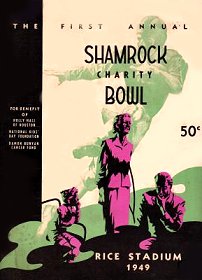
(A special thanks to Greg Bond, Department
Head of Vocational Nursing at Temple College, for the program
image above.)
|
|
|
To view summaries of all AAFC
championships games, click
HERE.
|

RETURN |