Indianapolis 500
1967

INDIANAPOLIS, Ind. (AP) - Parnelli Jones' "whispering wind" turbine car died awav and lost to A. J. Foyt, Jr.'s conventional rear-engine Coyote Ford in Wednesday's 500-mile auto race.
But controversy over use of an aircraft engine for the first time in the 56-year-old race had not quieted today. Henry Banks, director of competition for the U. S. Auto Club and himself a former national champion, said the question of running a turbine against piston engines "definitely will be brought up" at a June 5 meeting of the USAC rules committee.
"It's our job to keep the competition even; arranging formulas for that purpose is a foremost consideration," Banks said. "There were no ground rules for a turbine and we think we came up with a pretty good formula for one. All you can do for a new development is run it once and then reconsider."
Foyt picked up a record first place check for $171,227 at the Victory Dinner Wednesday night. Jones, who slipped to sixth in the wreck-halted race, got $48.392 including $27,000 in lap prizes for leading 171 of the 200 laps.
Foyt's record average was 151.207 m.p.h. against Jim Clark's 1965 mark of 150.686. Jones had one lap at 164.926, another record.
Second place Al Unser, Albuquerque, N.M., won 169,977 and third place Joe Leonard, Foyt's teammate, got 143,527. The total purse of $727,346.98 broke a record of $691,808.90 set last year.
The race, run in sections of 45 and 455 miles because of a Tuesday interruption by rain, proved that the STP-Pratt & Whitney turbine could go off and hide from any piston engine on the track whenever Jones hit the throttle.
A $6 ball bearing finally failed in the gear box with less than 10 miles to go and the dogged Foyt won as he had in 1961 when leader Eddie Sachs stopped to change a tire with only 2 1/2 miles to go.
Jones said he was running slowly and smoothly when the bearing went out. "I was going into the third," he said. "It felt just like pulling the car out of gear."
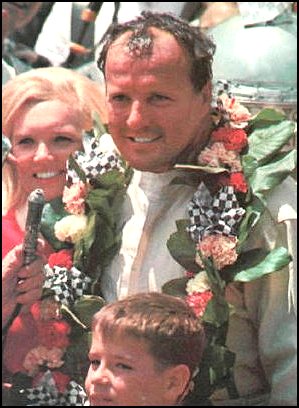
Foyt won the hard way in 1964 and joins the only other three-time winners, Louis Meyer, Wilbur Shaw and Mauri Rose.
Foyt said he might be in a turbine car himself next year if the rules aren't changed to bar it. He said he simply couldn't catch it when Jones was on the track.
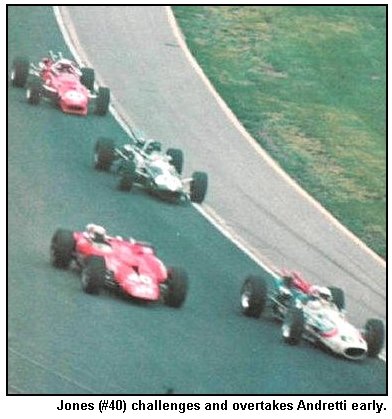
International racer Dan Gurney also tried gallantly but was washed out by a series of mechanical problems.
Foyt and Gurney pushed Jones as hard as they could and the 51st 500 literally was a three-car race.
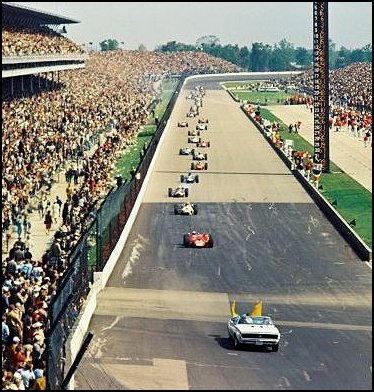
Foyt led twice before the finish as the indirect result of a rule for two compulsory pit stops for fuel. Jones made both of his stops before Foyt, who then led from the 80th through the 83rd lap and from the 131st through the 149th.
Each time Foyt made his own pit stop, Jones swished ahead easily and was in full command.
Whatever the merits of their equipment, Jones and Foyt upheld their reputations as two of the world's greatest drivers.
On the 51st lap, southern stockcar racer LeeRoy Yarbrough spun in front of Jones. Jones did a controlled spin, drove through the infield grass and went right on racing. This let Gurney lead the next two laps but the turbine soon was back in control.
The moment of truth for Foyt came as he rounded the last turn on his final lap. A drive shaft broke in Bobby Grim's car, tearing off a wheel, on the main stretch. Cars of Carl Williams and Chuck Hulse also crashed and other cars were sliding in all direction.
Foyt snaked through the mess on the track and took the checkered flag just before Chief Steward Harlan Fengler ordered the race stopped because the track was impassable (video).
Nobody was seriously hurt in a series of mishaps that kept the yellow "no passing" light on a total of one hour and four minutes. There had been only 13 minutes of running under the yellow when Clark set the old record in 1965.
Other crashes or spinouts eliminated Gordon Johncock, Larry Dickson, Mel Kenyon, Cale Yarborough, Johnny Rutherford, rookie Wally Dallenbach, and the qualification record setter Mario Andretti, who lost a wheel.
|
|
|
Gear Box Failed Jones In Race At Record Speed
 INDIANAPOLIS,
Ind. (AP)- For want of a healthy gear-box bearing, the fastest race in
500-mile motor classic history was lost by the revolutionary turbine car
driven by former Indy champion Parnelli Jones Wednesday.
INDIANAPOLIS,
Ind. (AP)- For want of a healthy gear-box bearing, the fastest race in
500-mile motor classic history was lost by the revolutionary turbine car
driven by former Indy champion Parnelli Jones Wednesday.
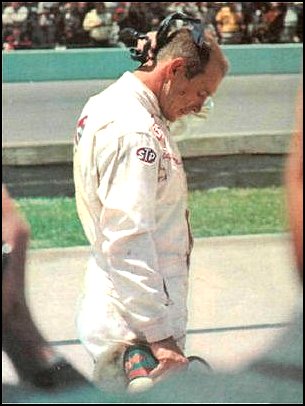
Jones, 1963 winner, who apparently had the 51st 500 race wrapped up in a fancy ribbon of record-breaking laps, was stunned but tight-lipped after his car stopped running less than four laps from the finish.
"I was fairly certain, as certain as you can be in this unpredictable race, that I would get the checkered flag," said Jones. "There were only four lap left and I was running very slow, taking no chances, as the yellow light was on. Then the trouble started without any indication of gear box failure."
Hard-luck Andy Granatelli, president of the Studebaker's STP division who thought he had a cinch winner in the turbine entry, had only a technical explanation of the car's startling home stretch collapse.
"You all knew we had gear problems earlier this month here, but it was not the gears, it was a bearing failure in the gear box."
The stunning turbine setback, which allowed Texan A. J. Foyt to surge his orange-red Coyote Ford to his third 500 triumph in seven years, may have collapsed a likely new Indy era.
Based on what the turbine showed in running away from the field before its incredible breakdown, a groundswell was growing to prohibit or drastically modify future turbine contenders.
Both Granatelli, who had a string of Indy failures previously with his high-powered Novis, and Jones declined comment on the possibility of racing the turbine further this year, or if they would return for a 1968 try.
The glowing red turbine, with its 550 horsepower engine nestled alongside of driver Jones, swished almost silently to lap record after lap record with the rest of the snarling, roaring rear-engined rivals trailing in seemingly hopeless pursuit.

RETURN
