|
First Round
Associated Press
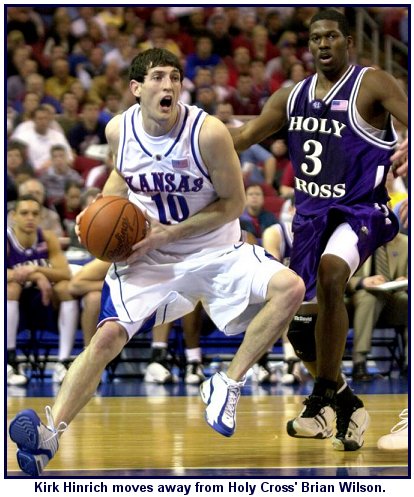  Kansas
looked nothing like a No. 1 seed in its NCAA Tournament opener. The
Jayhawks barely avoided becoming the first top seed to make a
first-round exit, holding off 16th seeded Holy Cross 70-59 on
Thursday night in the Midwest Regional at St Louis. Kansas
looked nothing like a No. 1 seed in its NCAA Tournament opener. The
Jayhawks barely avoided becoming the first top seed to make a
first-round exit, holding off 16th seeded Holy Cross 70-59 on
Thursday night in the Midwest Regional at St Louis.
Kansas trailed at
halftime for only the fifth time all year and was behind by five in the
second half before recovering.
"Everything looked bad,"
coach Roy Williams said. "But the kids didn't panic. Whether it's ugly or
not, we're still playing."
Beside beating Holy
Cross, the Jayhawks (30-3) also overcame their own history of failures-
five early losses as a No. 1 seed since 1986.
"No one wanted to go home
after this one," forward Nick Collison said.
Holy Cross almost sent
the Jayhawks limping back to Lawrence, Kan.
"It feels like someone
ripped out our hearts," guard Ryan Serravalle said. "We said in one of
the huddles in the second half we thought we'd make history together.
We're not satisfied with moral victories."
Kansas rallied without
all-Big 12 guard Kirk Hinrich, who sprained his left ankle in the final
minute of the first half. He returned on crutches with less than eight
minutes to go wearing an air cast and a heavy wrap, his leg elevated on
a chair at the end of the bench.
Hinrich, a junior, has
rolled the ankle several times in his career and his availability is in
doubt for the second round Saturday.
"Well, Kirk's ankle
doesn't look the best in the world, to say the least," Williams said.
"This is the first time I've ever seen him stay down."
All-American Drew Gooden
had 19 points and 13 rebounds to lead Kansas.
The victory over Holy
Cross (18-15), which won the Patriot League tournament, made it 19
straight first round victories in the NCAA Tournament for the Jayhawks.
But Kansas fell far short
of its nation-best 92-point scoring average, with its second-lowest
scoring total of the season.
Holy Cross befuddled
Kansas with a matchup zone all night and stayed in it until the end
despite shooting just 33.3 percent. The Crusaders compensated by
committing only 9 turnovers and by patiently working the ball inside
against Kansas' heralded big men.
Holy Cross led 44-39
after Patrick Whearty scored from inside with 14:27 to go, but the
Crusaders were hurt by foul trouble to Whearty, Serravalle and guard
Brian Wilson down the stretch.
Still, Kansas didn't
clinch it until Aaron Miles scored from the key with two seconds left on
the shot clock to make it 64-57 with 51 seconds to go. Holy Cross had
two consecutive takeaways but was stopped on the other end before Miles'
shot.
Second Round
 ST.
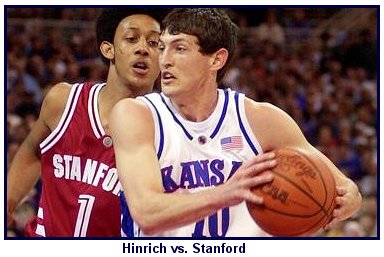
LOUIS (AP)- Doctors who were surprised at how quickly Kirk Hinrich
overcame a painful ankle sprain just don't know him as well as Kansas
coach Roy Williams. ST.
LOUIS (AP)- Doctors who were surprised at how quickly Kirk Hinrich
overcame a painful ankle sprain just don't know him as well as Kansas
coach Roy Williams.
With a brace on the left
ankle and thousands of Kansas fans fearing he might be out for the year,
Hinrich came off the bench Saturday night to score 15 points and lead
top seeded Kansas past Stanford 86-63 in the second round of the Midwest
Regional on Saturday night.
"The doctors were amazed.
They were really, really pessimistic," said Williams, who arrived at the
arena still thinking his All-Big 12 guard would not play.
"He's as tough a kid as
I've ever coached, as disciplined a kid as I've ever coached," Williams
said.
Hinrich went in and shot
6-of-9 from the floor and made 3-of-4 3-pointers against the
eighth-seeded Cardinal.
"I kept doing treatment
until the time we left (the hotel). I got out there in warmups and felt
pretty good," Hinrich said. "Once coach got me a chance out here, I got
some adrenaline going."
The 6-foot-3 Hinrich, the
Jayhawks' best defender, also spent much of the game guarding Casey
Jacobsen, Stanford's 6-6 swingman who had 24 points.
"I knew he was going to
play," Jacobsen said. "A player with one good leg played with more heart
than anyone on both squads."
Kansas (31-3) used a 15-0
run to open the game against the eighth-seeded Cardinal, and then closed
the first half on a 10-0 run, capped by Hinrich's jumper, to head into
the locker room with a 48-26 lead. The Cardinal (20-10) never put up
even a mild threat after that.
"It's tough enough to
play them straight, much less getting down big early," Stanford
forward Joe Kirchofer said. "They jumped on us early. We didn't do a good
job defensively."
After losing to Oklahoma
in the Big 12 tournament final last Sunday and struggling to beat
16th-seeded Holy Cross on Thursday, the Jayhawks appeared to regain the
rhythm and flow of the three-guard offense that made them the nation's
highest-scoring team with more than 91 points a game.
Their lead rose to 31
points twice in the waning minutes, the last with 5:09 left when Drew
Gooden hit from inside for an 82-51 lead.
Gooden was as amazed as
the doctors at the way Hinrich bounced back.
"He could barely walk two
days ago," Gooden said. "For him to come back and do what he did
tonight, and in only 21 minutes, that's impressive. That's Jordan-like."
Jeff Boschee had 19
points and Nick Collison, who had five points and six turnovers in the
ragged 70-59 victory over Holy Cross, rebounded with 17 points and 13
rebounds for the Jayhawks, who will make their second straight trip to
the round of 16.
"I was as motivated as
I've ever been because of the way I'd played," Collison said.
Hinrich, whose status was
in doubt until game time, came off the bench with 13:05 left in the
first half.
Less than three minutes
later, after Stanford's Curtis Borchardt shot an air ball, Hinrich
pulled up and hit a jumper to make it 23-9.
After Josh Childress hit
for Stanford, Hinrich drilled a 3-pointer at the 10:06 mark. Then, with
7:56 left in the half, he hit another long 3 to put the Jayhawks up
31-15.
Gooden, the Jayhawks'
All-America junior forward, had just four points in the first half but
finished with 15.
Three minutes into the
second half, Gooden stole the ball at midcourt and drove for a big dunk
to give Kansas a 58-32 lead. With 13:40 left, Boschee stole a pass and
threw the ball to Hinrich streaking down court, who fed Gooden for a
layup. The Jayhawks took a 58-32 lead moments later when Hinrich hit
another long 3. He was 3-of-4 from 3-point
range, and 6-of-9 overall.
�You don�t want to get
down by 20 points to a team like Kansas," Stanford's Chris Hernandez
said.
Borchardt had 13 points
and 11 rebounds for his 17th double-double for Stanford, which did not
score until he dunked with 15:29 left in the half.
Regional
Semifinal
By Lindsey Willhite
Chicago Daily Herald
 MADISON,
Wis.- With five minutes to go Friday, Illinois had two chances. Slim.
And none. MADISON,
Wis.- With five minutes to go Friday, Illinois had two chances. Slim.
And none.
Top-seeded Kansas'
defense was stuffing the Illini at every turn. Kansas' splendid freshmen
finally were getting loose on the break for layups.
In short, Kansas was
doing everything national championship teams do. But just when the
Jayhawks seemed ready to cruise into the Midwest Regional finals, the
Fighting Illini dug in.
Gradually and then
suddenly, Illinois found itself with two chances again. This time, it
was two chances to tie or take the lead in the final 30 seconds.
Only then did the
underdogs discover they could come no closer.
Brian Cook missed the rim
on an open 3-pointer that would have put Illinois up 1 point with 25
seconds left.
"I kind of caught it
off-balance and shot it a little off-balance, but that's my shot," Cook
said. "I'd shoot it again 100 times if I could."
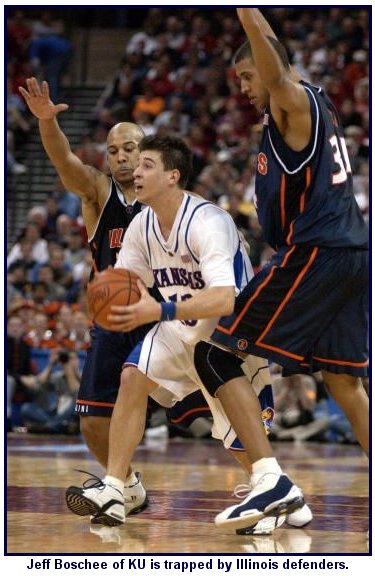
Then, after Kansas' Jeff
Boschee missed the front end of a 1-and-1, Frank Williams rimmed a
game-tying
15-foot baseline jumper
with five ticks left.
"We had a good look,"
Williams said. "I just didn't knock down the shot"
When calm Kansas freshman
Keith Langford converted both ends of a 1-and-1 with 2.8 seconds left,
the Jayhawks faithful could begin their long-delayed celebration.
Kansas avenged last
year's NCAA Midwest Regional semifinal loss to Illinois with a 73-69
victory Friday night before 16,310 at the Kohl Center.
The Jayhawks (32-3), who
got 15 points apiece from Langford and junior All-American Drew Gooden,
will play second-seeded Oregon (26-8) at 1:40 p.m. Sunday for a spot in
the Final Four. The Ducks defeated Texas 72-70 in Friday's first
regional semifinal.
"It was a battle all
night long," said Kansas coach Roy Williams. "I never felt like we got
comfortable."
"We couldn't have
scripted the game to go our way any better," said Illinois coach Bill
Self. "Until there was 2.8 seconds left, there was never a doubt in my
mind we were going to win the game."
Frank Williams provided
15 points in his final college game for Illinois (26-9), but he
converted just 6 of 18 shots from the field. The last one bounced off
the far side of the rim and into the Jayhawks' hands.
Senior center Robert
Archibald added 15 points and 10 rebounds in his final game, including
every crucial rebound down the stretch as the Illini chopped a 69-59
deficit with 5:10 left to 71-69 with 1:15 to go.
From there, the Illini's
game-long shooting woes knocked them out. Illinois shot just 38 percent
from the field as Kansas extended its man-to-man pressure further away
from the hoop than the Illini might have liked.
"I think their defense
interrupted our rhythm a little bit," Frank Williams said.
Kansas junior forward
Nick Collison picked up 2 fouls in the first 2 minutes and 23 seconds,
then earned his third with 5:35 left in the first half. Junior guard
Kirk Hinrich suffered his third foul with 12:02 left in the first half,
sat out until the second half and never got rolling.
"We lost to a team that
could very well cut down the nets in about 10 days," Self said. "I know
deep in my heart that, had a couple things gone differently, I think we
could have been the team in that same position possibly.
"Things just didn't work
out."
Regional Final
 Madison,
WI (AP)- Even Dick Bennett, the master of the slowdown offense, enjoyed
watching the Kansas Jayhawks. Madison,
WI (AP)- Even Dick Bennett, the master of the slowdown offense, enjoyed
watching the Kansas Jayhawks.
The former Wisconsin
coach had a front-row-view of Kansas' 104-86 rout of the Oregon Ducks in
the Midwest Regional final Sunday.
He was one of the few
local fans who cheered as Kansas Coach Roy Williams cut down the nets,
which were probably still sizzling after the Jayhawks' record point
production at the 5-year-old Kohl Center.
Williams raised the ire
of Wisconsin fans last season when he said after a high-scoring game,
"Don't you like this better than 19-17?"- a reference to the halftime
score at the Badgers' Final Four game in 2000.
Many Wisconsin fans felt
that was an attack on the Badgers' physical style of play under Bennett,
who retired 16 months ago.
"We buried the hatchet a
long time ago," Bennett said Sunday. "I love the way Roy's team plays.
This is high-level stuff."
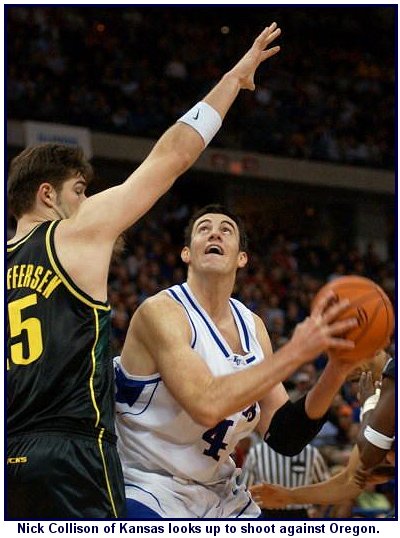
Drew Gooden and Nick
Collison each had double-doubles early in the second half as the
Jayhawks (33-3) reached their third Final Four under Williams, but their
first as a top seed in five tries during his coaching tenure.
Kansas controlled the
fast, end-to-end action and dominated the boards, outrebounding second
seeded Oregon 63-34. Indeed, Gooden and Collison outrebounded the Ducks
all by themselves- 35 to 34.
�It was tough because you
block one out and the other one would come out of nowhere," Ducks
forward Robert Johnson said. "They're a great 1-2 punch."
The Jayhawks grabbed 26
offensive rebounds, leading to 31 second-chance points.
"We knew the way to beat
them was to beat them on the boards and get extra shots," Gooden said.
"I think it was contagious. We were relentless out there on the
backboards."
Gooden had 18 points and
20 rebounds (video) and Collison added 25 points
and 15 rebounds, putting the Jayhawks in their first national semifinal
since 1993.
Kansas faces Maryland in
Atlanta next Saturday. The Terrapins beat Connecticut 90-82 in the East
Regional final.
Two other Jayhawks nearly
joined forwards Gooden and Collison with double-doubles. Freshman
reserve Keith Langford had 20 points and eight rebounds, and Kirk
Hinrich had 14 points and nine rebounds.
"They crash the boards
all the time, every single play," said Frederick Jones, who led the
Ducks with 32 points. "Their guards came in and got some, too. It was an
all-around effort."
The Jayhawks, the
nation's highest-scoring team with a 91-point average, outmuscled and
outhustled the beefier Ducks on the glass, fueling their up tempo game.
"I liked it because it
was up and down, even though we were beating each other back and forth
for layups," Gooden said. "I've got my shoes off. My dogs are hurting."
Kansas led 48-42 at
halftime and was up 73-59 when Oregon made its final run. Anthony Lever
hit back-to-back 3-pointers to spark a 10-2 Oregon burst that made it
75-69 with 8:30 remaining. Lever's third 3-pointer made it 77-72
seconds later.
But Kansas scored the
next 10 points, four by Collison, to end the Ducks' dreams of reaching
the Final Four for the first time since they won the first NCAA
championship in 1939.
It appeared as though the
Jayhawks were going to run away with it early, but the Ducks (26-9),
playing in a regional final for the first time in 42 years, scored 12
straight points, seven by Jones, to tie it at 40 with 2:57 left in the
first half.
But Oregon couldn't take
the lead and Collison scored three quick baskets as the Jayhawks built a
six point halftime lead.
Collison helped Gooden
provide a mismatch down low with the bigger but slower Johnson and Chris
Christoffersen, Oregon's 7-foot-2, 300-pound senior center.
"Those guys, for being
big, are extremely fast," Christofferen said.
When Ducks coach Ernie
Kent went with a small lineup, Williams stayed big, counting on his
bangers to clear the boards.
"We had more tired
signals today than in any game all year," Williams said.
Added Gooden: "It was as
fun game to play in, a really fun game. It hurt my feet, but it was
fun."
And it gives Williams,
who is 388-92 overall and 29-12 in the NCAA tournament, another shot at
that elusive national title.
"I do expect more out of
this team," Williams said. "I do want us to go to Atlanta with a
purpose."
National
Semifinal
 ATLANTA
(AP)- Juan Dixon made darn sure Maryland's return to the Final Four
didn't end after one game this time. ATLANTA
(AP)- Juan Dixon made darn sure Maryland's return to the Final Four
didn't end after one game this time.
With its All-American
guard leading the way, the Terrapins reached the national championship
game for the first time with a 97-88 victory over Kansas on Saturday
night.
Unlike last season when
the Terps blew a 22-point lead to Duke in its first Final Four
appearance, Maryland managed to make sure this big lead held up in the
matchup of No. 1 seeds.
"It was a strange
feeling. When the buzzer went off we were playing for the championship,"
coach Gary Williams said.
Dixon hit a baseline
jumper with 1:14 to play that gave Maryland an 89-82 lead after Kansas
had cut a 20-point lead to five. The Jayhawks still weren't done and
neither was Dixon, who finished with 33 points.
Kansas hit two 3-pointers
in the final 30 seconds. After the first, Dixon made two free throws to
make it 92-85. After the second, Kansas called a timeout it didn't have
and Dixon made one of two free throws on the technical to make it 93-88
with 19 seconds left. That was as close as the Jayhawks would get.
Maryland (31-4) will play
Indiana for the national championship on Monday night. The fifth-seeded
Hoosiers (25-11) advanced with a 73-64 victory over second-seeded
Oklahoma.
"A lot of people were
doubting Indiana, but a lot of people were doubting us," Maryland's Taj
Holden said.
Chris Wilcox added 18
points and nine rebounds for Maryland and Steve Blake had eight points
and 11 assists.
Now Williams has a chance
at his national championship and the Terrapins have an opportunity to
erase last season's nightmare. Many of the players said this week they
had still not gotten over the 95-84 loss to eventual
national champion Duke in Minneapolis.
Williams, who once played
for Maryland, celebrated the win with a chest bump with Wilcox.
Nick Collison had 21
points and 10 rebounds for the Jayhawks, while All-American forward Drew
Gooden finished with 15 points on 5-for-12 shooting and had nine
rebounds.
Things were far from
perfect at the start for Maryland, as Kansas (33-4) jumped to a 13-2
lead inside the opening four minutes.
 Rallying in the first
half seemed to fit the Terrapins much better than holding a big lead did
a year ago. Rallying in the first
half seemed to fit the Terrapins much better than holding a big lead did
a year ago.
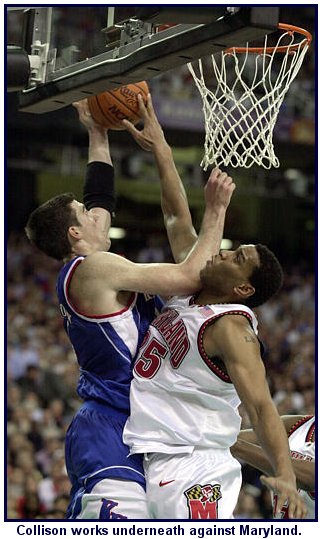
Despite center Lonny
Baxter being limited to three minutes in the first half because of foul
trouble, Maryland got back in it behind Dixon, the Atlantic Coast
Conference player of the year, who finished the first half with 19
points.
The Terrapins went up
44-37 at halftime and Kansas, despite getting in serious foul trouble
of its own, was able to stay within striking distance.
Jeff Boschee's 3-pointer
with 12:08 to play had the Jayhawks within 60-55. The Terrapins then
went on a 10-0 run, the last five points coming from Holden, and it was
70-55 with 10:08 left.
The Terps went up by as
many as 20 points, 83-63, on a 3 by Dixon with 6:04 to play.
Kansas, which was in the
Final Four for the first time since 1993, made it exciting with the late
run, but coach Roy Williams will again have to wait at least one more
season for his first national championship.
Boschee, who finished
5-for-13 from 3-point range and had 17 points, got the Jayhawks within
five points for the first time with a 3 with 2:04 left making it 87-82.
After Dixon's big shot
from the baseline and one free throw from Blake, Boschee made it 90-85
with his last 3 with 27
seconds to play.
Gooden's 3-pointer made
it 92-88 with 19 seconds left, but some of the Kansas players signaled
for a timeout when the ball went through. It may not have been as
dramatic as when Chris Webber made the same mistake for Michigan against
North Carolina in the 1993 championship game, but it cost the Jayhawks
dearly.
Dixon made the one free
throw on the technical and Byron Mouton added two on the ensuing
possession. Drew Nicholas capped the scoring with two free throws with
.1 second left.
The game provided the
expected offense. Kansas came in leading the nation at 91 points per
game and Maryland was a couple of spots behind at 85.3.
Dixon also provided what
he has throughout the tournament for the Terrapins, scoring at least 27
points for the fourth time in five games.
Looking ahead to playing
Indiana, he said: "It will be a tough game. This is our year, and
hopefully we come ready Monday night"
National
Championship Game
Sports Illustrated
April 08, 2002
Grant Wahl, Seth Davis
 All
night long, as his team bumbled and fumbled with an uncharacteristic
lack of poise, Maryland coach Gary Williams scowled. He stomped. He
screamed. And only when the game was over, when his players were
celebrating and his two-year-old grandson, David, was perched happily in
his arms, did Williams allow the widest of smiles to cleave his famously
agitated face. "Can you say, Go Terps!" he asked, kneeling to face David
on the Georgia Dome floor in Atlanta moments after Maryland had defeated
Indiana 64-52 in Monday's NCAA final. Let the record show that David- cut
from the same cloth as the hard-to-please Williams- simply tossed his
red-and-white pom-pom into his grandpa's face. All
night long, as his team bumbled and fumbled with an uncharacteristic
lack of poise, Maryland coach Gary Williams scowled. He stomped. He
screamed. And only when the game was over, when his players were
celebrating and his two-year-old grandson, David, was perched happily in
his arms, did Williams allow the widest of smiles to cleave his famously
agitated face. "Can you say, Go Terps!" he asked, kneeling to face David
on the Georgia Dome floor in Atlanta moments after Maryland had defeated
Indiana 64-52 in Monday's NCAA final. Let the record show that David- cut
from the same cloth as the hard-to-please Williams- simply tossed his
red-and-white pom-pom into his grandpa's face.
Williams burst out
laughing. How could he not, after his defense had smothered Indiana's
inside game, limiting the Hoosiers to 10-for-35 shooting from two-point
range? Or after his guards had flown at Indiana's three-point gunners,
pushing them out to NBA range and beyond? Or after Terrapins guard Juan
Dixon, the Most Outstanding Player of the Final Four, had shown why he
should have won player-of-the-year honors for the entire season?
Midway through the second
half of the sloppiest championship game in ages, just after Indiana had
erased a 12-point Maryland lead, Dixon pointed to his brother, Phil, in
the stands and delivered a message. "It's all right, it's all right,"
Dixon mouthed. "I got it." Indiana forward Jared Jeffries soon gave the
Hoosiers a 44-42 advantage, their first of the game, but from that point
on, Dixon made good on his word. He sank a cold-blooded three-pointer
over the outstretched hand of Indiana guard Tom Coverdale. Then, with
guard Dane Fife draped like kudzu over his shoulder, Dixon drove to his
left and drilled a preposterous fadeaway 15-footer, the two jumpers
kick-starting a game-breaking 22-5 run. "I wasn't nervous at all," Dixon
would say later. "I've been through tougher situations in my life. This
was nothing. I knew we were going to win."
"A lot of guys can score
20 points, but then they run and hide during the last few minutes," a
jubilant, sweat-soaked Williams said afterward. "Juan hits every big
shot for us."
While winning Maryland's
first national title, Williams showed that he's like a real-life
terrapin: He may have a hard shell, but he's soft and vulnerable inside.
Granted, Williams can be a raving, spitting, cursing maniac on the
sidelines. For years the worst place to sit at a Maryland game has been
on the bench, where the full brunt of his venom is often felt. In the
semifinal against Kansas last Saturday, just before center Lonny Baxter
reentered the game with two fouls, assistant coach Jimmy Patsos told
him, "Don't get a foul, because I don't want to get screamed at for the
next hour." What people fail to realize, though, is that if Williams's
players thought he was truly abusive, his teams wouldn't win. "Some guys
yell and scream, but their players don't reflect that intensity," says
UConn coach Jim Calhoun, whose Huskies lost to Maryland in the East
Regional final. "His teams reflect his intensity; that's what makes him
a great coach."
Yet Williams's antics are
misread more often than a treacherous downhill putt at Augusta. "I've
always felt that's the tip of the iceberg with me," he said in a quiet
moment last week. "I'm not quite what people think I am." Indeed, before
practice at the Georgia Dome last Friday, Williams sneaked up on senior
forward Byron Mouton, who lay on the floor of the Maryland locker room
listening to music with his eyes shut, and quietly dripped water onto
his face before scurrying off to hide in the bathroom. (Mouton never had
a clue that Williams was the culprit.) The night before, at an NCAA
event with the other Final Four coaches, Williams choked up and his eyes
filled with tears as he sat onstage at the Fox Theater describing his
love for his daughter, Kristin, and her son, David.
"People see Gary, and
they think he's a wild man," says Big East Conference commissioner Mike
Tranghese, one of Williams's closest friends. "I tell them Gary is one
of the kindest people I know, and they think I'm lying."
Like Dixon, whose
heroin-addicted parents both died of AIDS before he turned 18, Williams
sought refuge from a turbulent home life in what he speaks of
reverentially as "the game." From the time his parents divorced when he
was 14, he lived in an all-male household in Collingswood, N.J., with
his father, Bill, and his brothers, David and Doug. A check sorter at a
bank, Bill was an intensely private, devout Presbyterian who had no
interest in sports. Neither did Gary's mother, Shirley, who moved to
California after the split, or his brothers. Though he worked with Doug
on his father's funeral arrangements- Bill died in February of heart
failure, the day before Maryland beat Duke in Cole Field House- neither
brother has come to see Gary at the Final Four the past two years.
"We weren't one of those
families that were really close," says Williams, a team captain and
starting guard during his career at Maryland, from 1964-65 to '66-67,
"but the game was always a constant in my life. My parents got divorced,
but you could always go shoot a basketball if things weren't going well.
The great thing about basketball is, if you have a ball and a rim, you
can go play and you don't need anybody else around."
When Williams started his
own family, he continued to bury himself in the game. He still has a
hole in his heart from missing out on Kristin's childhood during the
years he was beavering away as an assistant at Lafayette and Boston
College and then as a head coach at American University, BC and Ohio
State. In 1990 Williams and his wife, Diane, split up after 22 years of
marriage, a painful reminder of his own broken home. Yet his life
changed, he says, when Kristin and her husband, Geoff Scott, gave him
his first grandson, David, in late 1999. "Once he became a grandfather,
there was a certain peace he felt," says Kristin, a part-time
schoolteacher who lives in Columbus, Ohio. "He just decided he wanted to
do things right. My dad keeps saying, 'You've got the rest of your life
to work on your career, but you're never going to get this time back
with David.' "
These days Williams
happily attends David's birthday parties, takes him to the zoo and even
crawls with the towheaded two-year-old into his nylon-mesh playpen
during trips to Columbus. Williams recently gave David a sweatshirt that
says PUT ME IN COACH, and he purchased a special kid-sized bed for his
grandson's visits to Maryland. "It's almost like a do-over," Williams
says. "When my daughter was two, I didn't realize how much fun that was
because I'd be thinking, I hope I can get that job, or, We've gotta go
see this kid play."
The boss's new approach
to his own life applies to his team as well. Williams lets his players
take half-court shots to end most practices ("When I played, it was,
'Practice is over, get dressed,' " says assistant Matt Kovarik, a former
Terps guard), and he offered an emotional apology to the team after its
ACC tournament semifinal loss to North Carolina State last month, taking
full blame for abandoning an effective zone defense that the players
wanted to stick with.
 But
the kinder, gentler Williams was nowhere to be found on Monday night,
not when he called a timeout after Indiana had tied the game at 40-40
with less than 12 minutes remaining. "There was a lot of yelling," says
junior forward Ryan Randle. "After he calmed down, he told us we had to
find a way to win. We knew if we started pounding it inside, we'd be all
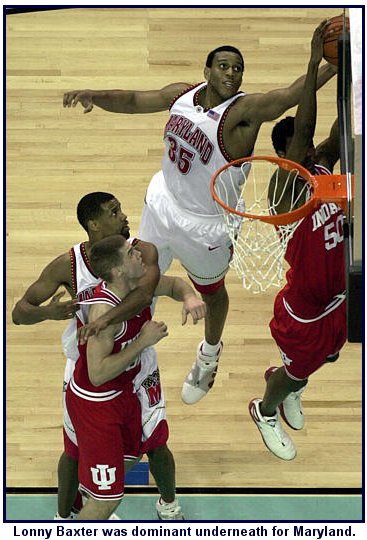
right." Duly admonished, Baxter bulled his way to the basket for a layup
on the next trip down-court, a scene that was repeated frequently down
the stretch as the Terps' burlier frontcourt of Baxter, Tahj Holden and
Chris Wilcox dominated Indiana's Jeffries, Jeff Newton and Jarrad Odle. But
the kinder, gentler Williams was nowhere to be found on Monday night,
not when he called a timeout after Indiana had tied the game at 40-40
with less than 12 minutes remaining. "There was a lot of yelling," says
junior forward Ryan Randle. "After he calmed down, he told us we had to
find a way to win. We knew if we started pounding it inside, we'd be all
right." Duly admonished, Baxter bulled his way to the basket for a layup
on the next trip down-court, a scene that was repeated frequently down
the stretch as the Terps' burlier frontcourt of Baxter, Tahj Holden and
Chris Wilcox dominated Indiana's Jeffries, Jeff Newton and Jarrad Odle.
These Terrapins have the
distinction of being the first team to win a national title without a
McDonald's High School All-American since that honorific was created in
1978. Williams has built his program on unheralded prospects like
Baxter, a once-overweight forward who played in the shadow of an NBA
draft pick (Korleone Young) on his high school team at Hargrave Military
Academy. Likewise, before Wilcox morphed into a surefire NBA lottery
pick, the 6'9" sophomore forward was a project from a backwater town
(Whiteville, N.C.). "The longer you coach, the more you realize you
don't have to have the best talent," Williams says. "You can beat teams
that might be a little more talented than you are if you're willing to
work harder. Plus it's more fun. You're not dealing with a bunch of guys
who are upset that they're still in college when they're juniors."
Or, as Randle cracked
after the Terps had dispatched Kansas (and its four McDonald's selects)
97-88 on Saturday, "Man, I guess we're gonna have to be Burger King
All-Americans."
In that case the smallest
of small fries is the perfect complement to Maryland's Whoppers. Dixon
was a 6'1", 145-pound wraith upon graduating from Baltimore's Calvert
Hall High- "My AAU coach, Anthony Lewis, called me World," says Dixon,
"because my head stood out so much on my body"- but Williams decided to
take a chance on him when he saw Dixon play at the Peach Jam, an AAU
tournament in Augusta, the summer before his senior year. "It was like a
thousand degrees down there," Williams recalls. "The game was a 20-point
blowout, his team was losing, and with two minutes left he dove on the
court for a loose ball. You see that and you say, Well, he's probably
going to work pretty hard when he gets to college."
Coaching careers can be
made on such tiny decisions. In his freshman year Dixon got better just
by lining up against All-America Steve Francis every day in practice. He
learned how to tighten up his footwork on offense and defense,
increasing his efficiency. He studied tape until his eyes glazed over,
learning his opponents' schemes. And he lifted weights like a Venice
Beach tough guy, improving his bench press from 100 pounds to 230 and
packing power into his twiggy legs. "When I first got to Maryland, I
couldn't grab the rim," Dixon says. "Now I'm dunking on a consistent
basis." More than that, he's a 165-pound first-team All-America with a
physique that Williams compares to a middleweight boxer's.
In Dixon, Williams also
discovered a kindred spirit, the lone Terrapin who isn't afraid to give
Williams some of his own medicine- "The only one," Patsos says, "who will
really give as good as he gets." During Maryland's opening-round defeat
of Siena, Williams went apoplectic after Dixon missed an ill-advised
three-pointer, whereupon Dixon turned and screamed, "Coach, shut the
f�-up!"
Warning-label utterances
are nothing new to Dixon, who, in the final minutes before every
tournament game, would pop Jay-Z's The Blueprint into his CD player,
listen to track 6 (U Don't Know) and conclude by repeating the last line
three times: "I will not lose ever. I will not lose ever. I will not
lose ever." In Saturday's semifinal Dixon put those words into action
with his jump shot, matching his career high with 33 points to sink the
Jayhawks. "Can you say a guy had a quiet 33?" Terps guard Drew Nicholas
asked afterward. "Everything he got was in the context of the offense.
It was amazing."
After Kansas had taken a
13-2 lead, Williams delivered a spittle-laced philippic. ("If we're
gonna lose this game, we're gonna lose it fighting. We aren't gonna be
punks!") Dixon answered by scoring 10 straight points, but his finest
moment came later, after another on-court exchange with his coach. With
just under two minutes to go, the Jayhawks had whittled an 83-63
Terrapins lead to 87-82. Memories of last year's Final Four collapse
against Duke, in which Maryland had gagged on a 22-point first-half
advantage, came flooding back to Williams, who later admitted that he'd
begun to contemplate what he'd say in the postmortem press conference if
the Terps choked again.
With Maryland sagging
against the ropes, Dixon clanged a three-point attempt, and suddenly
Kansas had the ball, but this time Williams had an entirely unexpected
reaction. "Take the next one!" he encouraged his star from the sideline.
Dixon nodded. Two years ago he sank a baseline runner at the MCI Center
in Washington, D.C., to beat Illinois, a shot the coaching staff
considers to be the moment Dixon became the Terps' leader. Sure enough,
after a defensive stop, he hit the same baseline runner the next time
down the court. Game over.
In Monday's title game,
two of Maryland's most important plays wouldn't even make it into the
box score, and both came courtesy of Mouton. Clinging to a 53-49 lead
late in the second half, Terps guard Steve Blake, suffering through his
worst performance of the year, missed a three-pointer, only to have
Mouton go after the loose-ball rebound and, while falling over the
baseline, throw a Hail Mary pass back to Blake at midcourt. "I just
wanted someone on my team to have a chance to get it," said Mouton, who
struck again a minute later, lunging wildly to tip Baxter's missed free
throw to Dixon. In both cases the Terps scored immediately. "Sick plays.
Just sick," Indiana's Fife would moan afterward. "But that's Mouton's
game. They run nothing for him on offense, so he digs for everything."
Second chances. They were
the story of the game, and so much more for Maryland and its
hard-driving, long-suffering coach. To understand Williams' newfound
equanimity, it's best not to gaze at his one-man sideline show. Instead,
you have to peer under that calcified shell and hope to catch a fleeting
glimpse as he sheds his $300 Italian loafers and climbs into his
grandson's playpen. In much the same way that Williams seized a second
chance with his family, he and his Terrapins redeemed themselves on
Monday, grabbing hold of the championship denied them by last year's
inglorious Final Four exit.
So thank you, Coach, and
thank you, Maryland, for reminding us once again: Do-overs are allowed,
in life and in basketball.
 |