|
First Round
  OKLAHOMA
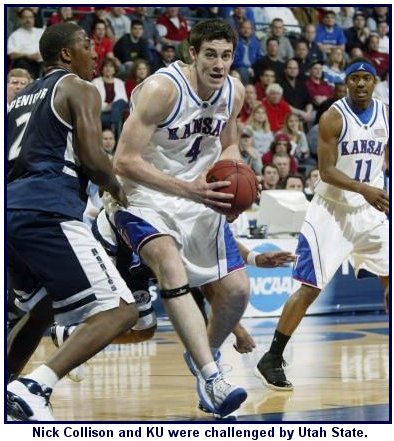
CITY (AP)- Apparently, it takes Kansas awhile to get going in the NCAA
tournament. OKLAHOMA
CITY (AP)- Apparently, it takes Kansas awhile to get going in the NCAA
tournament.
One
year after surviving a scare against 16th-seeded Holy Cross, Kansas held
on to beat No. 15 seed Utah State, 64-61, Thursday night at the West
Regional.
The
second-seeded Jayhawks (26-7) withstood two 3-point tries by Utah State
in the final 10 seconds and moved on to the second round to play
10th-seeded Arizona State, which beat Memphis 84-71.
"In
the back of everybody's mind, you realize if you lose, you're done,"
Kansas forward Nick Collison said. "But we weren't really scared, we
didn't really panic. We
felt Utah State was a good team. We're not really ashamed of the game."
The
Jayhawks questioned their seeding after winning the Big 12
regular-season title, but got more than just a tune up from Utah State
(24-9).
They
found a way to win, though- a late 7-0 run finally provided enough
breathing room, but just barely.
"We
thought we were going to win," said Desmond Penigar, who scored 25
points for the Aggies. "We planned it right, we watched film on 'em and
we knew what we had to do to win the game. We didn't want to come into
the tournament and just show up and be one of the games for Kansas to
move on."
Keith
Langford scored 22 points and Collison had 18 for the Jayhawks, who
reached the Final Four last season after rallying to beat Holy Cross in
the first round.
They
never trailed in this one and even led by 13 in the first half, but
weren't able to shake Utah State. The Aggies closed within four at
halftime and twice got within a point in the second half.
"I
think that would have really helped us if we could have gotten up a
point or two," Utah State coach Stew Morrill said. "It might have made
it a little tougher on them."
Langford had two baskets in a 6-0 run that gave Kansas a 42-35 lead
after Utah State cut it to 36-35 on a 3-pointer by Toraino Johnson.
Trailing 42-35, the Aggies scored six straight to again get within a
point. But Collison scored inside on a pass from Jeff Graves, then
assisted on a basket by Langford that pushed the lead to 46-41.
Utah
State got within two points five times in the final 10 � minutes, the
last time at 55-53 on a drive by Mark Brown with 3:53 left. That's when
Langford converted a three-point play, Collison scored inside and Kirk
Hinrich hit a layup off a turnover, giving Kansas a 62-53 lead with
2:35 left.
But
Utah State didn't go away. Brown made a 3-pointer to make it 62-58, then
Penigar hit one with 47.2 seconds left to make it 64-61.
After
a Kansas turnover, Utah State called timeout with 10.3 seconds
remaining. Penigar missed a 3-pointer from the top of the key and, after
a scramble, Cardell Butler missed another 3 as the buzzer sounded.
"We
just couldn't grab the ball," Collison said. "It was bouncing around
like a pinball. I'm not going to lie, I was holding my breath on that
last one."
The
Jayhawks appeared to have things in hand after a 13-5 run made the score
26-13 with 7:23 left before halftime. But Utah State's zone defense
slowed the Jayhawks in the closing minutes of the half. Kansas coach Roy
Williams said he considered himself lucky.
"It
was just a weird ending," he said. "At the same time, I've seen a lot of
teams, including Kansas last year, go pretty far when they struggled to
win the first game."
Second Round
 OKLAHOMA
CITY (AP)- The Kansas Jayhawks are off and running again, all the way
West and into the round of 16 for the third straight year. OKLAHOMA
CITY (AP)- The Kansas Jayhawks are off and running again, all the way
West and into the round of 16 for the third straight year.
Seniors Nick Collison and Kirk Hinrich sparked the Jayhawks right from
the opening tipoff Saturday night in a 108-76 win over Arizona State, an
offensive showcase light years removed from their first-round struggles
against Utah State.
Second-seeded Kansas (27-7), a Final Four team a year ago, heads to the
West Regional semifinals in Anaheim, Calif., against either Duke or
Central Michigan.
Collison scored 22 points and had 10 rebounds, and Hinrich scored 24 as
the Jayhawks topped 100 points for just the fifth time in the school's
98 NCAA tournament games.
The
Jayhawks are in the round of 16 for the ninth time in coach Roy
Williams' 15 seasons.
Jason
Braxton scored 17 for the 10th-seeded Sun Devils (20-11), who were in
their first NCAA tournament since 1995.
Williams had challenged Hinrich and the entire team after their tough
64-61 win over Utah State.
The
Big 12 regular-season champions wasted little time returning to form as
one of the nation's highest-scoring offenses. Kansas did just about
anything and everything it wanted, shooting 68 percent and hitting 14
consecutive shots during a second half run that made what was already a
rout look even worse.
It was
easy pickings from the start.
Collison scored on a layup for the game's first points, Hinnch swished a
3-pomter from the right corner for a 5-0 lead and the Jayhawks never
looked back. Collison dunked, converted a three-point play and started a
three-way give-and-go with Aaron Miles and Keith Langford that Langford
finished with a tomahawk dunk for a 16-4 lead.
Hinrich swished another 3-pointer from the corner and a jumper by Miles
made it 34-12 with 6:37 left in the half.
The
Sun Devils, meanwhile, didn't show any of the offensive form they had in
a 84-71 first round win over Memphis. Arizona State started four seniors
but the experienced lineup looked shaky. The Sun Devils fired up several
airballs and had nearly as many turnovers (eight) as field goals (11) in
the first half.
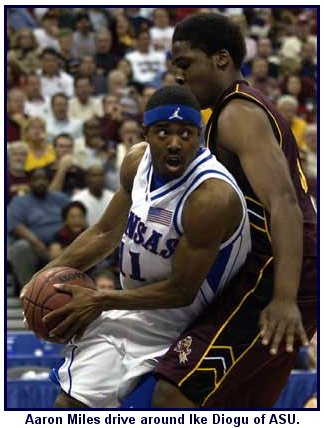
Freshman Ike Diogu, the Pac 10 freshman of the year, held his own on the
offensive end against Collison with 10 points in the first half. But he
was no match defensively for Kansas' savvy senior, the Big 12's career
scoring and rebounds leader.
In the
second half, Arizona State missed four of its first five shots, before
cutting it to 49-37 on Tommy Smith's dunk. But Collison dunked on the
other end, hit a jumper and the Jayhawks had the lead back up to 60-41
with 15 minutes to play
That's
when frustration finally set in for Arizona State Coach Rob Evans was
hit with a technical for complaining about the officiating.
Regional
Semifinal
The
Dallas Morning News
 ANAHEIM,
Calif.- Nick Collison went it alone Thursday night. The best player in
the country, according to Duke coach Mike Krzyzewski, was enough for
Kansas (video). ANAHEIM,
Calif.- Nick Collison went it alone Thursday night. The best player in
the country, according to Duke coach Mike Krzyzewski, was enough for
Kansas (video).
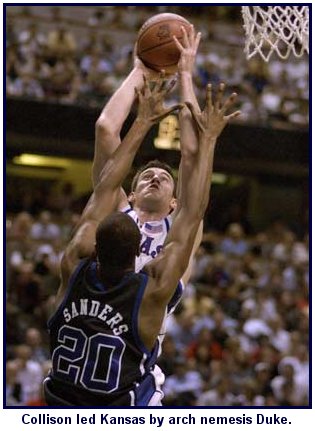
Lacking the usual assistance of guard Kirk Hinrich, Collison carried
Kansas to a 69-65 victory over Duke in an NCAA West semifinal game at
the Arrowhead Pond. Collison had a career-high 33 points and 19
rebounds, the last of which stopped Duke's last gasp rally.
"A
fantastic game," said Kansas coach Roy Williams, who beat Krzyzewski for
the first time in four tries. �It's the kind of game where you feel
fortunate to win."
Duke
threw so many extra defenders at Collision that it was almost funny," he
said.
Collison thought Duke was trying to make him turn passive. It did not
work.
Collison had several stretches in which he singlehandedly kept
struggling Kansas in the game.
Duke
opened a 44-36 lead early in the second half. Collison kept Kansas
(28-7) from falling out of sight. He scored six of the Jayhawks' next 11
points on a putback, a running left-handed hook and a short jumper to
wipe out Duke's lead.
Collison was even better late in the game. He had Kansas' final six
rebounds and performed the Herculean feat of outscoring the entire Duke
team, 12-8, during a seven-minute stretch late in the game.
Seven
points came with Hinrich on the bench because of foul trouble. Hinrich,
who averaged 17.5 points during the regular season, went more than 27
minutes before his first score and finished with four points.
"I was
trying to be aggressive and make plays the whole game," Collison said.
"When Kirk went out, I really didn't try to do anything different."
The
game was tied at 35 at the half. There were four more ties in the second
half before Collison roared away, pulling the Jayhawks with him in his
draft.
Duke
(26-7) saw the downside of its late-season affection for the perimeter
shot.
The
Blue Devils had a 38.5 shooting percentage and scored only six point in
the final 4:48. Freshman J.J. Redick, 15-for-31 on 3-pointers during the
five-game winning streak, was 1-for-11 on threes and 2-for-16 overall.
Duke
stayed with the small lineup and let-it-fly offense that has served it
well during postseason play.
The
Blue Devils made five of their first seven three-point tries to go
ahead, 22-13. Kansas could not aim its defense at one shooter. Five Duke
players made a 3-pointer during that stretch.
Collison kept Kansas in the game during Duke's early storm of
3-pointers. Duke's small lineup had no one who could effectively defend
Collison.
Regional Final
 ANAHEIM,
Calif. (AP)- Nick Collison did it one game, Kirk Hinrich the next.
That's how it works at Kansas, and the payoff is a trip to the Final
Four. ANAHEIM,
Calif. (AP)- Nick Collison did it one game, Kirk Hinrich the next.
That's how it works at Kansas, and the payoff is a trip to the Final
Four.
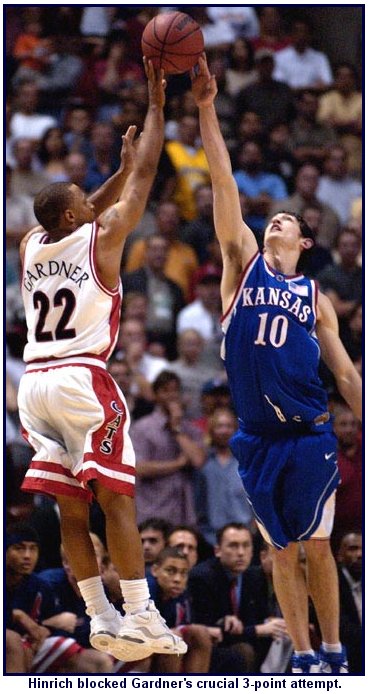
Hinrich went from his least productive performance of the season to one
of his best, scoring 28 points and blocking a three-point attempt by
Jason Gardner in the final seconds Saturday night as the second-seeded
Jayhawks beat top-seeded Arizona 78-75 at the Arrowhead Pond to win the
NCAA West Regional (video).
"He
struggled three or four games this season and the next game, he was
sensational," Kansas coach Roy Williams said. "He was sensational today.
He always competes."
The
victory was the 1,800th for Kansas- third-most in NCAA history. The
Jayhawks will play in their 12th Final Four, the fourth in Roy Williams'
15 years as coach.
Williams has a 417-100 career record and his .807 winning percentage is
the best among active coaches, but he's never won a national
championship.
This
team appears poised and ready.
"I
feel awfully good right now," Williams said.
So
much for that anticipated Arizona-Kentucky matchup in the national
semifinals at New Orleans. Instead, the Jayhawks (29-7) will face
Marquette at the Superdome. The third-seeded Golden Eagles (27-5)
stunned No. 1 Kentucky 83-69 earlier Saturday to win the Midwest
Regional.
The
Jayhawks blew leads of 16 points in the first half and 14 in the second,
but did enough in the end to win.
"It's
starting to sink in," said Luke Walton, one of Arizona's three senior
starters.
"I
know it's going to be the last time in the locker room with the coaches,
the players. That's the hardest part, knowing that it's all over and
we're not going to have another shot at it."
Hinrich was a miserable 1 of 9 from the field and scored just two points
in Kansas' 69-65 victory over Duke in the regional semifinals.
So
Collison took over, scoring a career-high 33 points and grabbing 19
rebounds in a performance Williams called the best he's ever had by one
of his players in a big game.
The
Wildcats made life difficult for Collison in this game, holding him to
eight points and nine rebounds. So Hinrich took over.
"I
think I just knew how big a game this was," the 6-foot-4 senior said. "I
don't remember ever being so anxious and giddy before a game. I knew
against Duke, I wasn't the aggressor. I got frustrated early and forced
some shots.
�Today, I just wanted to come out strong. If I was going to go down, I
was going to go down firing."
Hinrich fell one point shy of his career high. He shot 10 of 23,
including 6 of 17 from three-point range, and added five rebounds, five
assists, two steals and two blocks. The second block won't soon be
forgotten in Kansas.
After
the Jayhawks committed a shot-clock violation, the Wildcats took
possession with 7.1 seconds remaining. Gardner let fly from about 25
feet away, but Hinrich slapped the ball away. Walton grabbed it and fed
the ball back to Gardner in the left corner, but his second attempt to
tie the game missed as time expired, setting off a wild Kansas
celebration.
"I
knew he was going to shoot it. I was able to get my hand up and get a
piece of it," Hinrich said. "I think my height helped."
Gardner said he had a good look at the second attempt, but it just
didn't go down.
The
loss was a tough one for Arizona and 68-year-old Hall of Fame coach Lute
Olson, who remained stuck at 499 wins in his 20 seasons as leader of the
Wildcats.
Jeff
Graves had 13 points and 15 rebounds, and Keith Langford also scored 13
points for Kansas. Collison sat out key minutes down the stretch with
four fouls, but his second basket of the game with 1:27 left gave Kansas
a 76-73 lead.
Langford made a free throw with 4:31 remaining to cap a 69-69 tie and
put the-Jayhawks ahead for good, and his runner with 50.6 seconds to go
completed the scoring.
The
sophomore guard then drew a charging foul on Walton with 43.4 seconds
left, setting up the final sequence.
"I'm
going to have to live with it," Walton said. "I probably should have
shot the three."
Gardner led the Wildcats (28-4) with 23 points. Walton had 18 points, 10
rebounds and six assists, and Rick Anderson and Hassan Adams scored 11.
It was
the last game for seniors Gardner, Walton and Anderson. But Hinrich and
Collison- key seniors on the other side- get to play on.
Arizona outscored Kansas 18-4 to finish the first half and start the
second, erasing all but two points of a 16 point deficit.
It was
reminiscent of a game between the teams Jan. 25, when the Wildcats
trailed by 20 before outscoring Kansas 67-30 to finish the game for a
91-74 victory that snapped the Jayhawks' 23-game home-court winning
streak.
Just
when it appeared the Wildcats were in control. Kansas went on a 14-2 run
capped by Bryant Nash's breakaway dunk to go ahead 56-42.
That
only seemed to stir up the Wildcats, who scored the game's next 16
points- eight by Gardner- in just over three minutes for a two-point
lead with 10:32 remaining. Neither team led by more than four after
that.
Hinrich was called for traveling in the final minute of the first half,
prompting an angry display from the normally mild-mannered Williams.
First, he tore off his jacket and threw it on a chair behind the Kansas
bench. Then, he stomped toward the official who called the violation,
voicing his disapproval, but it was to no avail.
The
game was delayed for five minutes because the scoreboard wasn't working.
The lights came on shortly after the opening tip. Olson and Williams
exchanged a few words- and chuckles- in front of the scorer's table
during the delay.
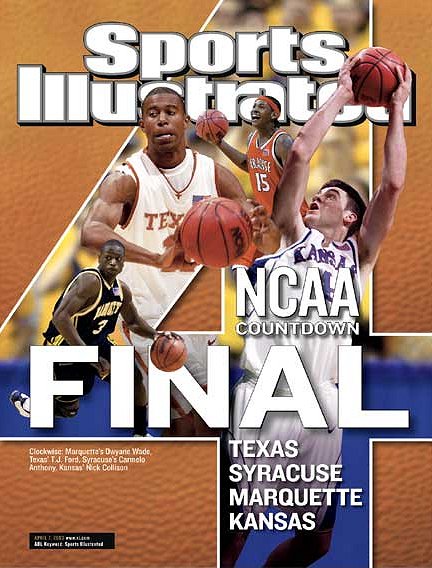
National
Semifinal
By
Lindsey Willhite
Chicago Daily Herald Sports Writer
 NEW
ORLEANS- The rest of the world will remember Saturday's first Final Four
semifinal for Kansas' breathtaking fast break and cold-blooded
efficiency. NEW
ORLEANS- The rest of the world will remember Saturday's first Final Four
semifinal for Kansas' breathtaking fast break and cold-blooded
efficiency.
Marquette will think of that initially.
Then
the Golden Eagles will recall how, in the school's first Final Four
appearance since 1977, they laid a not-so-golden egg.
On the
strength of a stunning first half that nearly found No. 6 Kansas
rewriting a generous portion of the Final Four record book, the Jayhawks
cruised into their first NCAA championship game since 1991 with a 94-61
whipping of No. 9 Marquette before 54,432 fans at the Louisiana
Superdome.
Kansas' 33-point victory margin was the fourth-largest in the Final
Four's 65-year history and the game wasn't that close.
"Needless to say, the first 25 to 30 minutes were sensational," said
Kansas coach Roy Williams. "I feel very, very fortunate and very, very
pleased."
"First
of all, (Kansas) played a great, great basketball game in every facet,"
said Marquette coach Tom Crean. "We contributed to it by not... we did
not have a day like this all year.�
"We
missed so many easy shots around the basket, we could never get that
little run where we could get that confidence we needed."
Meanwhile, Kansas ripped off the mother of all runs during the middle
portion of the game.
Starting with Kirk Hinrich's 3-pointer at the 13:15 mark of the first
half, the Jayhawks blistered Marquette 63-22 over the next 18-plus
minutes to build a 77-34 advantage with 14:51 to go.
Not
only did the Jayhawks score quickly and furiously, they did it without
regard for what Marquette did on its offensive end.
Kansas
pushed the ball on the break on Marquette's 6 first-half turnovers. It
pushed the ball whenever it rebounded one of Marquette's 32 first-half
missed shots. It pushed the ball on Marquette's rare makes.
Perimeter blurs Keith Langford, Aaron Miles and Kirk Hinrich delivered
on the other end- almost always with more than 25 seconds left on the
35-second shot clock
On
five occasions in the first half, Kansas answered a Marquette basket
with one of its own within nine seconds.
"You
know, every team is capable of running," said Langford, who led all
scorers with 23 points. "It�s not just running faster than anyone, it's
just the fact we're going to continue to do it.
"I
think a couple of possessions they kind of celebrated their score
(while) we were on the other end attacking and scoring. We just kept
pushing."
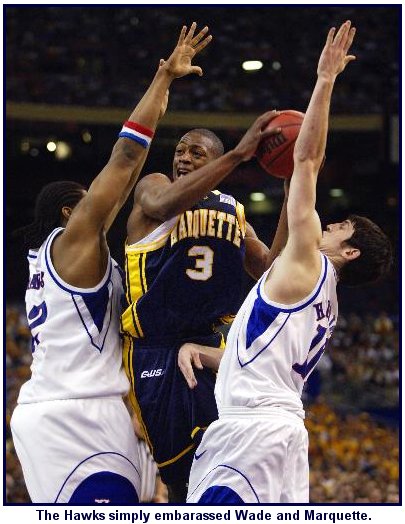 And
Marquette just kept panicking. And
Marquette just kept panicking.
"We
were paralyzed a few times," Crean said. "We were standing around and
not getting back."
"We
didn't do a good job of communicating and getting back on defense like
we did all week in practice,� said Marquette sophomore point guard
Travis Diener. "They made us look pretty bad."
Diener, who had been Marquette's rock throughout its remarkable NCAA
run, might have looked worst of all. After committing just 4 turnovers
in his last four games, Diener committed turnovers on Marquette's first
two possessions.
His
day didn't get any better as he finished with 5 points on 1-of-11
shooting while committing a career-high 8 turnovers.
Junior
guard Dwyane Wade led Marquette with 19 points, but he forced several
contorted shots during Kansas' dizzying run in a vain attempt to keep
his team in contact.
"I
feel like we didn't get into the flow on offense as good and that was
partly our fault," Wade said. "We didn't really listen to Travis when he
was railing the plays. Guys were out of position. Kansas is a great
team, but I think we were out of position more and wound up having to
force a shot up."
Meanwhile, the Jayhawks kept their feet all the way down on the gas
pedal until Williams removed his final starter with 3:41 to go and
Kansas ahead 92-52.
Did
they ever start to feel sorry for Marquette?
"Nope," said Langford.
"Nope," said senior forward Nick Collison, who scored 12 points, grabbed
15 rebounds and triggered KU's break.
Williams probably would have said, "Nope," too. With 5:30 to go and
Kansas up by nearly 40, he was still up on the sidelines and giving the
officials grief for missing a goaltending call.
"I
think the biggest thing for us was we kept attacking,� Williams said.
"That was something we talked about all the time throughout the course
of the entire season- and we emphasized it in the locker room before the
game today."
Now
Williams, in his fourth Final Four, gets another chance to win his first
national championship.
Wade,
for one, thinks Williams will be wearing a net around his neck at about
10:45 p.m. Monday.
"If
they go out and play the way they did tonight," Wade said, "I don't
think they can be stopped."
National
Championship Game
Sports
Illustrated
April
14, 2003
Alexander Wolff
 To
be golf coach was best. At Syracuse in the early 1970s, back when the
athletic department could justify the salary only by piling additional
duties on a graduate assistant basketball coach, Jim Boeheim preferred
coaching golf for one reason: No one knew the results unless he phoned
them in. Imagine a Final Four that worked that way. No Nantz and Packer;
no scrum of coaches in a hotel lobby down the street; no one knowing
what happened unless Jim Boeheim called with the news. "That was a lot
more fun," Boeheim said last week, recalling his golf-coaching days.
"Everyone thought we were undefeated." To
be golf coach was best. At Syracuse in the early 1970s, back when the
athletic department could justify the salary only by piling additional
duties on a graduate assistant basketball coach, Jim Boeheim preferred
coaching golf for one reason: No one knew the results unless he phoned
them in. Imagine a Final Four that worked that way. No Nantz and Packer;
no scrum of coaches in a hotel lobby down the street; no one knowing
what happened unless Jim Boeheim called with the news. "That was a lot
more fun," Boeheim said last week, recalling his golf-coaching days.
"Everyone thought we were undefeated."
No one
had that misapprehension about the two Syracuse teams Boeheim took to
the Final Four before this year, especially the one he brought to New
Orleans in 1987. The world knows that the Orangemen had been on the
business end of Keith Smart's shot with four seconds to play, the jumper
that won Indiana an NCAA title. It took years for Boeheim to get over
the pain of that loss, and the game tape remains the only one he has
never watched. "I wish we'd have won that game, but would my world
really be different if that shot hadn't gone in?" he asks. "I don't
think so. I never thought Marv Levy would have been a better coach if
he'd won one of those Super Bowls."
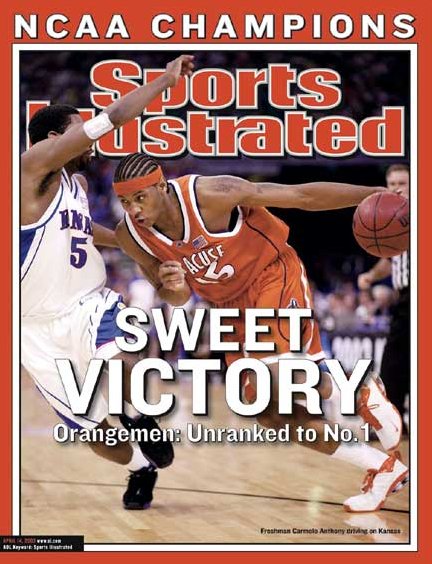
Boeheim was no better a coach by the end of this season, even after
squeezing all he could out of a one-year wonder of a freshman named
Carmelo Anthony, including Monday night's 81-78 defeat of Kansas in the
Superdome for the NCAA title. He might, however, have been a different
man. According to his wife, Juli, he had never before told one of his
players "I love you," as he did to Anthony, a 6'8" forward, after the
Orangemen qualified for New Orleans with their East Regional defeat of
Oklahoma.
And
what's not to love? From his sweet dish to center Craig Forth for the
first basket of the title game, to his graceful pirouette while calling
timeout in the final minute as Syracuse clung to a lead, to his 20
points, 10 rebounds and six other assists, Anthony embodied the credo
tattooed to his right biceps, LIVE NOW/DIE LATER. "Ain't nothing left
for him to do," said Anthony's brother, Justus, in the postgame tumult.
Nor,
it seems, is there much left for his coach to accomplish after 27 years.
"There's four seconds he has to clean up," Kueth Duany, Syracuse's lone
senior regular, said of Boeheim last week, before Anthony and fellow
freshman Gerry McNamara delivered the title by playing with more poise
than the Jayhawks' senior leaders, Nick Collison and Kirk Hinrich.
"Those are the four seconds we're trying to get for him." And get them
these unlikely champions did, replacing four final seconds with a Final
Four first (video).
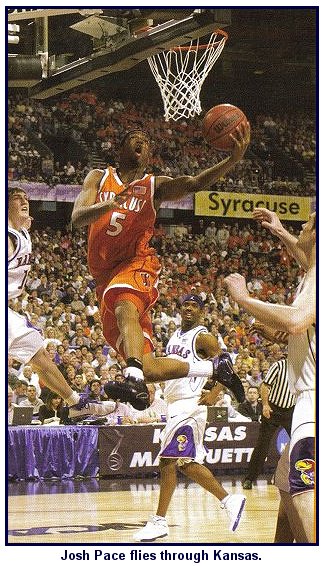 Much
of the Syracuse narrative leading up to Monday night had been delivered
by television, and for almost a quarter century that story line had
been, alternately, boon and bane. During the 1980s and into the '90s,
ESPN's images of a full Carrier Dome served as recruiting infomercials,
particularly effective in Southern California, where impressionable high
school stars, home from practice and waiting for dinner, would tune in.
Many wound up making the surprising decision to go where winters are
long and the local industry is air conditioning. At the same time,
sideline cutaways always seemed to show Boeheim in full caterwaul, and
to judge by his expression and body language, he liked neither people
nor life, much less basketball, thereby establishing his reputation as a
grouch and a yokel. (He didn't do much to dispel it. Asked once why he
so rarely took his teams to tournaments in Hawaii, he said with a
harrumph, "Ah, Hawaii. Syracuse in July.") Boeheim had also mined New
York City for recruits, like the play-maker Dwayne (Pearl) Washington,
maestro of those teams in the early '80s. But the next great Gothamite
point guard to come along, Kenny Anderson, chose Georgia Tech. A comment
attributed to a member of Anderson's family may be apocryphal, but it
had the ring of an epitaph: "That city's cold, and that man is, too." Much
of the Syracuse narrative leading up to Monday night had been delivered
by television, and for almost a quarter century that story line had
been, alternately, boon and bane. During the 1980s and into the '90s,
ESPN's images of a full Carrier Dome served as recruiting infomercials,
particularly effective in Southern California, where impressionable high
school stars, home from practice and waiting for dinner, would tune in.
Many wound up making the surprising decision to go where winters are
long and the local industry is air conditioning. At the same time,
sideline cutaways always seemed to show Boeheim in full caterwaul, and
to judge by his expression and body language, he liked neither people
nor life, much less basketball, thereby establishing his reputation as a
grouch and a yokel. (He didn't do much to dispel it. Asked once why he
so rarely took his teams to tournaments in Hawaii, he said with a
harrumph, "Ah, Hawaii. Syracuse in July.") Boeheim had also mined New
York City for recruits, like the play-maker Dwayne (Pearl) Washington,
maestro of those teams in the early '80s. But the next great Gothamite
point guard to come along, Kenny Anderson, chose Georgia Tech. A comment
attributed to a member of Anderson's family may be apocryphal, but it
had the ring of an epitaph: "That city's cold, and that man is, too."
Still,
Boeheim carried on. He earned the respect of other coaches with his
20-win seasons- 25 in all- and his feel for the game, especially in
learning and incorporating its many styles. "He's very dangerous once
they throw it up, because he sees the game globally," says Dave Gavitt,
the founding commissioner of the Big East, the conference that gave
Boeheim the national stage upon which he seemed so uncomfortable,
especially alongside such outsized coaching personalities as John
Thompson, Lou Carnesecca and Rollie Massimino. But, as Gavitt says,
"Jimmy's a very provincial guy, and all of a sudden his world was
national." And although no Division I coach has been in the same place
longer than Boeheim, other schools never really tried to hire him away.
He attracted plenty of talented players, yet among NBA scouts they had a
reputation for not always developing and not always practicing hard.
Syracuse, you could say, was the UCLA of the East.
Then
Jules met Jim. With a gesture as old-fashioned as a blue blazer or a 2-3
zone, Boeheim caught the eye of a stunning Kentuckian some 20 years
younger, Juli Greene. At a Derby party in Louisville in 1995, she had
returned from the ladies' room to find her spot on the sofa taken.
Boeheim created a place for her and pulled up a chair. They fell into
conversation, then a game of backgammon; he rebooked his flight to stay
another day, and she taught him how to dance the two-step. A year and a
half later, after he had dropped to one knee in the laundry room of his
Syracuse home to ask if she would marry "this old stiff," she did.
Boeheim had grown up in the upstate New York town of Lyons, the son of
an undertaker. The family home doubled as a funeral parlor, and little
Jimmy quickly learned that it was good business to subordinate one's
emotions to those of the family's customers. The critical point here is
that Boeheim wasn't emotionally one-dimensional all those years; he was
just raised to be opaque with his feelings. "He's basically a very shy
guy who's finally reached a comfort level," Gavitt says.
"Everybody says that Jim has changed so much, but he really hasn't,"
Juli says. "What the public is starting to see now is the only Jim I've
ever known."
Boeheim remains friendly with his first wife, Elaine, and their adopted
daughter, Elizabeth, 17, who live in Syracuse not far from Jim and Juli
and their three kids, Jimmy, 4, and three-year-old twins Jamie (a girl)
and Jack. Nearly every day the two boys push aside the dining-room
furniture for a hoops game of their own devising, Starting Lineup, in
which one plays for Syracuse and the other for some NBA team. Their
58-year-old dad may play a little defense or even cheer one of the boys'
moves. But he's never a coach. "I'm always the coach at home," says
Juli, a remark that's worth reading at more than one level.
A year
ago Boeheim underwent treatment for prostate cancer, the disease that
had taken his father's life, but long before that he was involved in the
Coaches vs. Cancer charity. It's a cause that fits perfectly with Juli's
Bluegrass hostessing skills, and together the Boeheims help stage the
black-tie Basket Ball, an annual gala that accounts for Syracuse's
easily leading all schools in raising funds for that organization. Only
a few weeks ago he and the team taped a promotional spot for this year's
event, which is set for April 26 and will feature the Temptations.
Boeheim opens the promo with a spiel, then adds some Motown
choreography. His players, unprepared for a Temps-style spin move,
dissolved into such hysterics that the director couldn't use the take,
and this upset Boeheim, who insists that his best move wound up on the
cutting-room floor. "I used to tell him that there'd be no name on his
tombstone, just a caricature of him with his glasses hanging on his
nose," says Gavitt, mimicking the Boeheimian sourpuss expression with
arms imploringly outstretched.
The
current Orange players, of course, know only one Boeheim, and it's not
the misanthrope of Big Mondays past. "I heard he used to throw chairs in
the locker room," says Forth. "But he hasn't thrown one since I got
here. And when he does get on you, it gets you motivated. You want to
win for him- sometimes just to prove him wrong, but sometimes just to
make him happy."
The
team made him happiest with how it played the 2-3 zone, which is nothing
like that Mickey Mouse setup you'll recall from CYO days. Today Syracuse
looks for long-armed, long-bodied players with quickness and skills- such
as 6'8" sophomore forward Hakim Warrick- and those physiques lend
themselves to an effective 2-3.
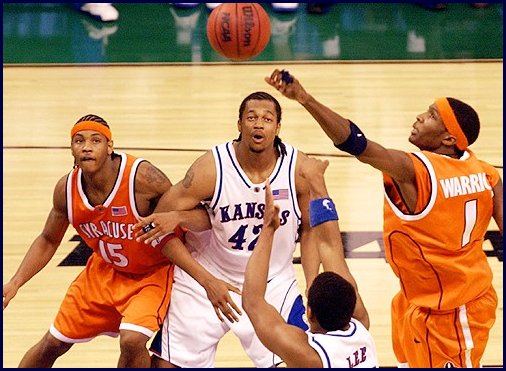 In
the East Regional final the 2-3 so flummoxed Oklahoma that the Sooners
had more turnovers (19) than baskets (18). In last Saturday's 95-84
semifinal defeat of Texas, the top of the zone dared T.J. Ford to shoot,
and when the Longhorns' point guard penetrated, the back line cheated
forward enough to keep him from probing deep into the lane. "I played a
lot of zone in high school, but there's no zone like this," says
Warrick, who made the crucial block of Michael Lee's last-second
three-point attempt in Monday's final. "You'd never think there's this
much to it. It's like a 400-level class." In
the East Regional final the 2-3 so flummoxed Oklahoma that the Sooners
had more turnovers (19) than baskets (18). In last Saturday's 95-84
semifinal defeat of Texas, the top of the zone dared T.J. Ford to shoot,
and when the Longhorns' point guard penetrated, the back line cheated
forward enough to keep him from probing deep into the lane. "I played a
lot of zone in high school, but there's no zone like this," says
Warrick, who made the crucial block of Michael Lee's last-second
three-point attempt in Monday's final. "You'd never think there's this
much to it. It's like a 400-level class."
Because zones are so rare these days, most teams don't have highly
refined offenses to run against them. "You have to make shots against a
zone," says Gavitt. "And to get good shots, you have to pass the ball
with sonic imagination. Kids today can do just about everything better
than in the old days except passing. So if you throw a zone out there
and it's active and working, a lot of teams can't make you pay."
Moreover, the zone may surrender shots, but often in unaccustomed
places, like the midrange. And while so many teams avoid playing the 2-3
for fear of giving up the three-point shot, Syracuse will sometimes
extend on the wings, inviting opponents to prove that they can
consistently get the ball in the foul circle and sink that simpler, but
less damaging, two-point shot or make a high-low pass for a layup.
Yet
even his great tactical creation has brought Boeheim as much grief as
praise. "I'm still doing the same things," he says. "We just have better
players this year. It's funny: If we lose, it's always that we shouldn't
be playing the zone. You lose with a man-to-man, it's somehow better."
The
Orange sometimes even traps out of its zone, nowhere more effectively
than in the "short corner," the horse latitudes where the foul lane
meets the baseline. Opponents who pick up their dribble there may find
themselves looking beseechingly at a pom-pom girl, the only friendly
face they can find. Eventually, opposing players get what Duany calls
"the bug-eyed look...like they're lost and confused."
That
described Syracuse a year ago, when discipline problems and dissension
tore the team apart. Boeheim pronounced it his most difficult season as
a coach, quite apart from his bout with cancer. The departure of three
players created room for a scorer and a floor leader, roles that Anthony
and McNamara, respectively, have assumed. Given their transforming
influence on the team, those two aren't freshmen so much as refreshmen.
"I've never seen Jim have so much fun with a team," says Juli. "Last
year the phone would ring, and you'd know it wasn't good. This year
those calls never came."
Not
that the season passed without its dodgy moment. Credit Boeheim with a
deft bit of peacemaking in January, shortly after the return of
first-year guard Billy Edelin, who had been suspended for 12 games by
the NCAA for playing in an unsanctioned summer league. Edelin feared
that McNamara had claimed his minutes. Anthony didn't think McNamara was
getting him the ball enough, and he was bugged that the press was making
such a big deal over Edelin's arrival. Boeheim spoke with all three
individually, then gathered them in his office to bring them together.
"After that meeting our roles were clear," says Edelin.
Anthony and McNamara combined for 38 points and nine three-pointers
against Kansas, including six three-pointers by McNamara in the first
half. "We tried not to double off McNamara," Collison said after the
title game, "but when Anthony gets the ball, everyone's got to give
help."
"They
make a mistake here and there," Boeheim said of his freshmen after they
beat Texas, "but these kids are young enough to think they can do
anything, and I'm not going to tell them differently."
McNamara will remain an Orangeman for three more years. The only
question surrounding Anthony's future, after the NBA-style clear-outs
with which he dominated both games last week to win the Most Outstanding
Player award, is whether he may now be threatening LeBron James's status
as the likely No. 1 pick in the June draft. For all the skills he
showcased over the weekend- feathering jumpers, plucking rebounds,
finding teammates and, yes, laying Temps-style spin moves on Kansas
forward Keith Langford- the lasting image of Anthony may be one that
captured his unburdened attitude. Late in the first half he stood in
front of the scorer's table, waiting to check in, smiling and waving two
towels as the Syracuse lead crested at 18. Coaches are from Earth;
players are from Pluto.
As for
the Mars-and-Venus Department, there's this to report from Monday night:
Before One Shining Moment could be piped through the Superdome's PA.
system, Boeheim turned to his wife, said "Let's go home" and tried to
lead her into the tunnel. To which Juli replied, "This is my favorite
part. We can't go yet." And he stayed.
In the
end, even as Carmelo Anthony departs, isn't that the epitaph Jim Boeheim
deserves? HE STAYED. Indeed, Syracuse's only unexpected phone call this
season will be the call in which Boeheim phones in the score to the
fates.
Syracuse 81, Kansas 78. Four seconds, freshly laundered. Ah, New
Orleans: Syracuse in April.
 |